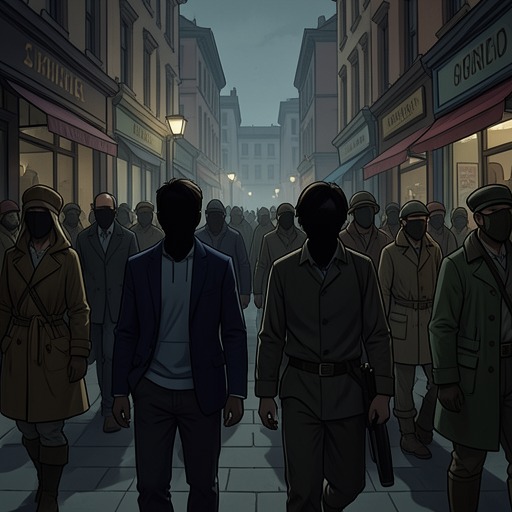
Intimate separation
Love VirtuallyThe intimate non-encounter names the central paradox of Emmi Rothner and Leo Leike’s relationship: an intense private intimacy formed through emails that neither becomes an ordinary shared life nor can be neatly concluded by remaining virtual. After their first and last meeting fails, Leo frames their bond as something whose singularity depends on stopping at the brink; Emmi answers that a relationship defined by not meeting needs one face-to-face encounter for its fitting conclusion. Their disagreement is not merely about whether to meet. It is about whether an unrealized intimacy should be preserved by withdrawal or completed, however briefly, through physical presence.
A relationship held at the brink
In Leo’s account, the failed meeting is the decisive break. He says that he cruelly ended their virtual relationship on that dreadful night, when Emmi had reached a decision she did not want to acknowledge until the end and he helped her carry it out. He does not know the current state of her life with Bernhard and her family, and explicitly says he does not want to know: for him, those circumstances belong outside the private space of the two of them. His insistence draws a boundary around their intimacy even as it acknowledges that their lives continue beyond it.
Leo describes the ensuing silence as necessary. The two of them, he argues, needed to protect the one-of-a-kind quality of their experience and preserve their private inner intimacy as a non-encounter. They had taken their relationship to the brink, but it had gone no further; he sees no future for it, especially now that he has met someone in Boston and is trying to begin a relationship with her. The non-encounter is therefore both a limit and a keepsake: the failure to become a shared physical life is what allows Leo to regard their connection as singular and intact.
The meaning of a conclusion
Emmi initially tells Leo she will make herself scarce and stop withdrawing into his life, though her promise that she will send no more emails is qualified by the word “soon.” She then asks for one last wish: one hour face-to-face. She does not present the hour as a demand for a continuing relationship. Instead, she argues that there could be no better way to preserve their shared experience, and that a meeting is the only sensible conclusion to an intimate relationship whose defining form has been not meeting.
Her request is insistently physical and specific. Emmi wants to speak to Leo, smell him, see his lips say her name, and see his eyelashes once before the curtain falls. These details make the gap between email intimacy and embodied presence concrete. The correspondence has allowed a closeness that feels measured and sustained, but it has withheld the face, breath, voice, and gestures through which two people encounter one another in person. Emmi’s proposed hour would not undo that history; she presents it as the final scene capable of giving the history a shape.
She also accepts Leo’s central prediction: she says there is no meaningful future for them. What she disputes is the conclusion that the relationship should simply be left where it stands. By asking for a “fitting conclusion,” she distinguishes an ending from a continuation. The encounter she wants is at once an act of recognition and a farewell, though the evidence does not establish that it takes place.
The body beyond the screen
In a later message, Emmi interprets Leo’s hesitation as his recurring, dormant fear of contact with her. She needles him by contrasting the prospect of meeting with a preference for talking about “large breasts,” then proposes a conversation about their childhoods. What matters to her, she says, is not the form or content of his words but how he says them. The imagined meeting is less an exchange of information than an opportunity to observe Leo as a speaking, listening, breathing person.
That emphasis clarifies what the virtual relationship has both made possible and kept absent. The emails have carried an intimacy Emmi calls close, intimate, and seemingly endless yet curtailed, fulfilled yet unfulfilled. Their form can sustain attention to the other person’s language while leaving the body unseen. Emmi’s repeated wish to see Leo talk, listen, and breathe turns that formal absence into the immediate subject of her appeal: she wants to meet the person whose presence she has experienced through words.
A meeting proposed, not secured
The correspondence does not settle the argument by demonstrating that the encounter occurs. After an exchange that leaves Emmi grateful for what Leo has said, she proposes seeing him at two o’clock at Café Huber. The invitation offers the concrete possibility she has been pressing toward, but it remains a proposed appointment in the evidence here, not confirmation of a completed meeting. That distinction keeps the intimate non-encounter suspended between an actual failed first meeting and the hoped-for face-to-face conclusion.
As a governing idea, the intimate non-encounter holds closeness and absence together rather than resolving one into the other. Leo treats the limit as a protection for a singular experience; Emmi treats it as an unfinished ending that can be made fitting only through one hour of physical presence. Their emails preserve both positions in the same relationship: a bond powerful enough to feel intimate, and a boundary that leaves the desired encounter uncertain. The form of the correspondence makes that uncertainty palpable, because every renewed message can approach the meeting without itself becoming the meeting.